![[personal profile]](https://www.dreamwidth.org/img/silk/identity/user.png)
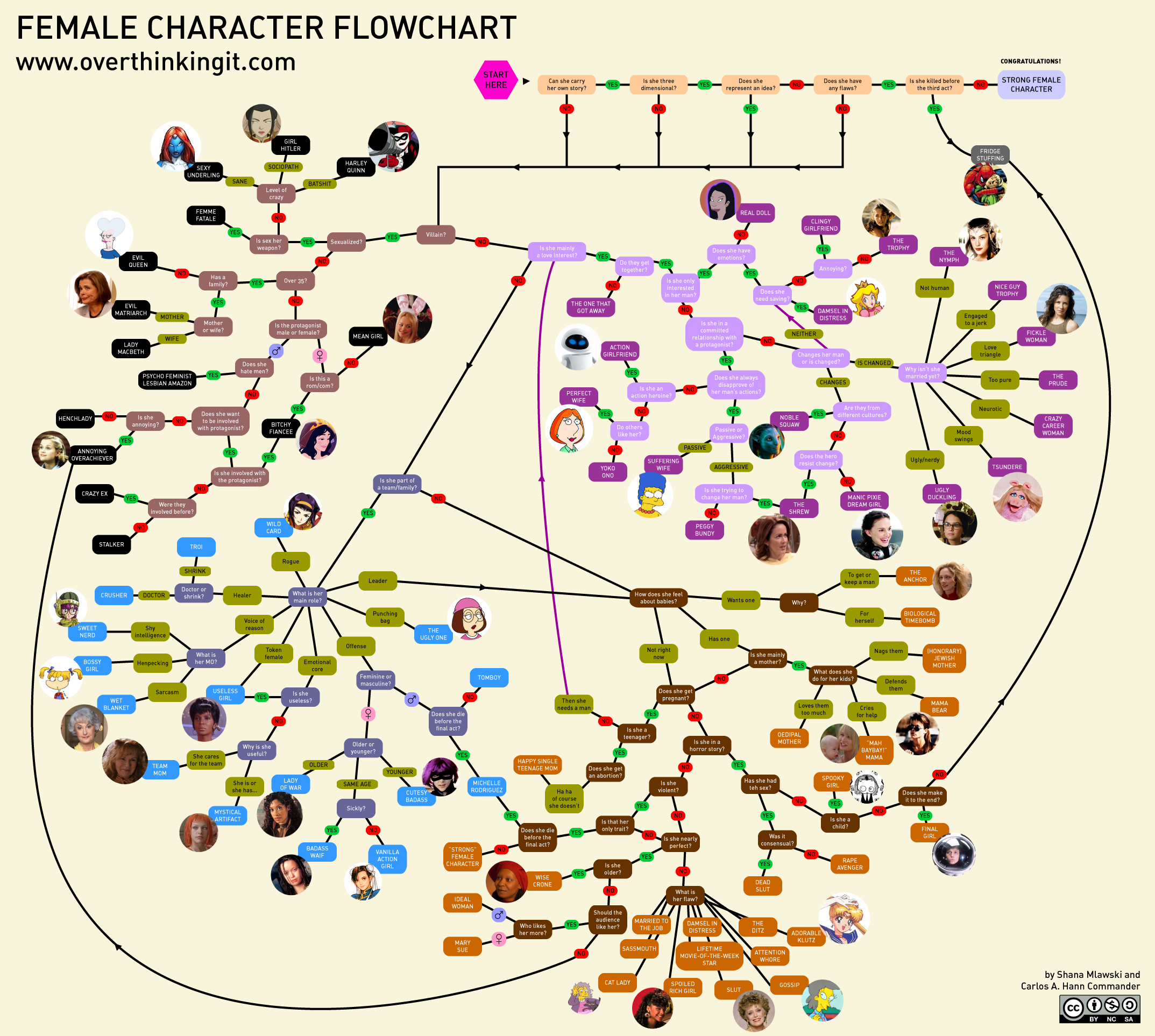
Fair warning: I have been reading ![[livejournal.com profile]](https://www.dreamwidth.org/img/external/lj-community.gif) metafandom a bit too much lately. But the Female Character Flowchart has been making such extensive rounds that I've started to see it elsewhere as well. It's popping up on facebook, twitter... and I'm fascinated by how, outside of LJ, all of the reactions I've seen have been "Yeah... the state of female characters is pretty sad," whereas most of us in this corner of fandom are up in arms about how some of our favorite female characters got thrown onto the chart or, from a wider standpoint, how the chart implies that any female character that serves a supporting role is not a "Strong Female Character". Some of you might remember my last diatribe on "Strong Female Characters" (which is locked due to real-life things touched upon in that entry, sorry), which mostly boiled down to my conclusion that 80% of the time I don't hold up to most "strong" character standards, so what are we even looking for if real, actual people don't pass muster? (And this happens on the list, too. I mean, Yoko Ono is on it and, as much as she's reduced to a trope in pop culture, she is still a real person.)
metafandom a bit too much lately. But the Female Character Flowchart has been making such extensive rounds that I've started to see it elsewhere as well. It's popping up on facebook, twitter... and I'm fascinated by how, outside of LJ, all of the reactions I've seen have been "Yeah... the state of female characters is pretty sad," whereas most of us in this corner of fandom are up in arms about how some of our favorite female characters got thrown onto the chart or, from a wider standpoint, how the chart implies that any female character that serves a supporting role is not a "Strong Female Character". Some of you might remember my last diatribe on "Strong Female Characters" (which is locked due to real-life things touched upon in that entry, sorry), which mostly boiled down to my conclusion that 80% of the time I don't hold up to most "strong" character standards, so what are we even looking for if real, actual people don't pass muster? (And this happens on the list, too. I mean, Yoko Ono is on it and, as much as she's reduced to a trope in pop culture, she is still a real person.)
And this is where I would wave my hands around and shout "Stop conflating 'strong' with 'well-written' in terms of characters." Nevermind how 'strong' tends to be a masculine ideal and putting the first on the list of traits for a female is counter-intuitive at best... well-written is what matters. (And I can't even get into the whole problem this raises with flawed vs. too flawed. And goodness, once we've determined, in that straight little line that supposedly leads to narrative perfection, whether someone is flawed enough or not they get dumped into the same reductionist morass as everyone else that can't carry their own story or exists as a soapbox for someone's ideas.) So let's say that our gold-star "Congratulations!" category is for Well-Written Female Characters. But I'll be honest here, I suspect that Lara Croft makes it across that fine line at the top, and in a chart where that happens but Faye Valentine and Zoe Wasburne are relegated to substandard status is more than a bit flawed (not that both of those characters don't suffer from writer-inflicted oversight problems). And that's my main argument against the chart. It's more concerned with a war against tropes than it is with what actually makes a good character, regardless of gender, and it doesn't seem to distinguish at all between the different roles protagonists play versus supporting characters.
But I'm determined not to go off on another rant on this stuff. Instead, I want to have a bit of fun with this chart. I've been skimming through it for the better part of a half-hour now, trying to figure out where I fit on it. I mean, I'm constantly going on about how my life has a secret author, after all, so it's only appropriate for me to figure out where I stand.
I'm going to come straight out with my hypothesis (because otherwise I will never manage to organize this entry at all). Because if you take your own life as a story, where you fall on the chart depends entirely on how you cut it. Every story is just a piece of a whole world (that's why fanfic has a place to flourish), and all of the characters in it technically have their own individual story going on. And I think this is something it's fair to assume for every character, whether the writer actually manages to portray that or not. I mean, let's face it, one-dimensional and stereotypical characters do serve a purpose (though I'm certainly not going to argue that they're always going to be put to good use). And, honestly, look at the people in your life that you only sort of know. The check-out guy in the grocery store with the weird haircut, the bank teller you always see, the boss you have that shares random out-of-context personal details. Are these three-dimensional characters? No, not from your point-of-view. But are they not real people? (Without straying into philosophy here, guys.) I like to think that there are three dimensions to any character, even if we don't get to see them, and that's the way I view most fictional characters. If it's not there, I tend to make up the rest, and that's probably why I forgive so much I shouldn't when it comes to writers messing things up.
So. Back on track here, a character's role and dimension depends on how you slice the story. I'm currently fascinated by the role I fulfill if you just lift my office out into its own narrative. In this scenario let's assume we're working with an ensemble cast and I'm not the main character, so that automatically bumps us down to the villain question. With a few exceptions mostly having to do with my hatred of our process servers, I don't really fit the villain category, and I'm not a love interest. Since we're looking at my office, it is a team-oriented story, and that gives me approximately eight choices for who I am. If we're telling the story from any other department's point of view, I'm almost invariably the shy-nerdy voice of reason. If we're looking from an attorney's point of view, I am anywhere from Rogue to Punching Bag, depending on the day and whether I've tried to contact a certain stupid large national bank that is not our main client lately (since there doesn't seem to be a 'She does whatever we throw at her/Jack of all trades' category, I suppose I'll say I'm mostly a Rogue in regards to the attorneys). And if we take it from my department's standpoint, I get to hop over to the circle of 'Leader' characters. Ignoring my propensity to categorize my job as a horror story, I'm not violent and I'm certainly not 'nearly-perfect,' so that leaves me in the 'Married to her job' category. Which isn't terribly inaccurate, I suppose, but apparently still makes me a not-strong female character. But let's go back to 'nearly-perfect' because I love this one. It gets leveraged against female characters all the time, because something deep in our insecurity makes us point to other girls and go "Too perfect!" I have, in fact, had this finger pointed at me at work several, if not many, times. Because I'm a goody two-shoes, because I put in extra hours without complaining, because et cetera. And so here, because some of the other women in my office resent the fact that, by not complaining about extra work, I am actually obligating them to do more work without complaining as well or risk irking the bosses, I slip into the annoying overachiever category (or, assuming an audience that isn't my co-workers, I am an 'Ideal Woman', presumably because my male bosses like me. But if I was a bit older I would be a wise crone, and maybe miraculously I wouldn't be resented anymore? Or, if the genders in my office were switched and the female attorneys liked me more than my male co-workers, I would be a Mary Sue?)
At this point I feel like my point would be made better by walking an actual, fictional, female character through this chart, so the nonsense you encounter by trying to implement this really comes to light. Because what it's coming to, outside of the meta issues at stake here, is that the role of all of these female characters boils down to point-of-view. (So, what does it say about our point of view here that I (we?) disapprove so intensely of this chart? What does it say about the chart-creator's point of view?)
I was going to take Temperance Brennan through the chart, but I realized pretty quickly that, since she is a titular character of a show she pretty much gets a free pass through the top line. Congrats, Bones, you can hang with Lara Croft. So I suppose it follows that this chart is effective as an argument against the lack of female protagonists. But that makes the whole bottom of the list terribly unnecessary, and as much as I'd like to look at the chart in this light, even my powerful inclination to retcon things doesn't extend that far.
And actually, I think that might be where all of our problems arise. The first question is whether the character can carry her own story, but that question then seems to be treated as whether the character does carry her own story. Just because some of these women are not written as main characters doesn't mean that they couldn't carry their own story, it just means that a different point-of-view was chosen for telling the story they were involved in. (I'm confident that the original authors of several of these characters, at least, would do a fine job of making them into main characters in their own stories.) And it's an even bigger problem that, since all of the first three turn-offs lead to the same place, it's basically implied that all the women in the branches off of the main line can't carry their own story, and are either too perfect or too soapboxy. I think it's this implication that has people up in arms, and I'm left thinking maybe without the examples, this would be a much better chart. (So I erased everyone. Which I guess makes me a villain.) Without the pictures we could stop focusing on figuring out how certain of our favorite characters were deemed unable to carry their own story, or without flaws, or too representative of an idea, and focus instead on how, if you're a female leader of a team, it's still possible for your main purpose in the story to be "the Gossip". (What?) Which is the sort of error that's the real failing of this chart. The examples lead to the dead-end logic that characters don't fit more than one trope, but more importantly the lines themselves lead to overly reductive and dismissive conclusions about female characters in general.
Which feels like a conclusion in a crappy college gender studies essay, but whatever. It's Sunday night and I have nothing better to be doing.
I guess, what I'm generally getting at when I pick up these arguments is that it's absurd to have some predetermined "Ideal Female Character" archetype, because there is no way it can be fulfilled realistically. And yes, I think that is what this chart is implying, because it relegates every trope to substandard status. So, in order to be a strong female character, you need to carry your own story, be just flawed enough, and not representative of anything readily recognizable (which I can only assume is how a lot of those characters got onto the bottom of the list). I remember having this argument countless times in college, with people who would tear other people's writing apart for "clichés" that were really just tropes. People have a habit of thinking that, just because they recognize something as an idea they've seen used before, that it must be a cliché and taken out back and burned. I feel like I tend too much toward ultra-realism in my demands for fiction, but at the same time, an unattainable standard for a certain group of characters, especially an entire gender's worth of characters, is arguing too hard for ultra-fiction.
metafandom a bit too much lately. But the Female Character Flowchart has been making such extensive rounds that I've started to see it elsewhere as well. It's popping up on facebook, twitter... and I'm fascinated by how, outside of LJ, all of the reactions I've seen have been "Yeah... the state of female characters is pretty sad," whereas most of us in this corner of fandom are up in arms about how some of our favorite female characters got thrown onto the chart or, from a wider standpoint, how the chart implies that any female character that serves a supporting role is not a "Strong Female Character". Some of you might remember my last diatribe on "Strong Female Characters" (which is locked due to real-life things touched upon in that entry, sorry), which mostly boiled down to my conclusion that 80% of the time I don't hold up to most "strong" character standards, so what are we even looking for if real, actual people don't pass muster? (And this happens on the list, too. I mean, Yoko Ono is on it and, as much as she's reduced to a trope in pop culture, she is still a real person.) And this is where I would wave my hands around and shout "Stop conflating 'strong' with 'well-written' in terms of characters." Nevermind how 'strong' tends to be a masculine ideal and putting the first on the list of traits for a female is counter-intuitive at best... well-written is what matters. (And I can't even get into the whole problem this raises with flawed vs. too flawed. And goodness, once we've determined, in that straight little line that supposedly leads to narrative perfection, whether someone is flawed enough or not they get dumped into the same reductionist morass as everyone else that can't carry their own story or exists as a soapbox for someone's ideas.) So let's say that our gold-star "Congratulations!" category is for Well-Written Female Characters. But I'll be honest here, I suspect that Lara Croft makes it across that fine line at the top, and in a chart where that happens but Faye Valentine and Zoe Wasburne are relegated to substandard status is more than a bit flawed (not that both of those characters don't suffer from writer-inflicted oversight problems). And that's my main argument against the chart. It's more concerned with a war against tropes than it is with what actually makes a good character, regardless of gender, and it doesn't seem to distinguish at all between the different roles protagonists play versus supporting characters.
But I'm determined not to go off on another rant on this stuff. Instead, I want to have a bit of fun with this chart. I've been skimming through it for the better part of a half-hour now, trying to figure out where I fit on it. I mean, I'm constantly going on about how my life has a secret author, after all, so it's only appropriate for me to figure out where I stand.
I'm going to come straight out with my hypothesis (because otherwise I will never manage to organize this entry at all). Because if you take your own life as a story, where you fall on the chart depends entirely on how you cut it. Every story is just a piece of a whole world (that's why fanfic has a place to flourish), and all of the characters in it technically have their own individual story going on. And I think this is something it's fair to assume for every character, whether the writer actually manages to portray that or not. I mean, let's face it, one-dimensional and stereotypical characters do serve a purpose (though I'm certainly not going to argue that they're always going to be put to good use). And, honestly, look at the people in your life that you only sort of know. The check-out guy in the grocery store with the weird haircut, the bank teller you always see, the boss you have that shares random out-of-context personal details. Are these three-dimensional characters? No, not from your point-of-view. But are they not real people? (Without straying into philosophy here, guys.) I like to think that there are three dimensions to any character, even if we don't get to see them, and that's the way I view most fictional characters. If it's not there, I tend to make up the rest, and that's probably why I forgive so much I shouldn't when it comes to writers messing things up.
So. Back on track here, a character's role and dimension depends on how you slice the story. I'm currently fascinated by the role I fulfill if you just lift my office out into its own narrative. In this scenario let's assume we're working with an ensemble cast and I'm not the main character, so that automatically bumps us down to the villain question. With a few exceptions mostly having to do with my hatred of our process servers, I don't really fit the villain category, and I'm not a love interest. Since we're looking at my office, it is a team-oriented story, and that gives me approximately eight choices for who I am. If we're telling the story from any other department's point of view, I'm almost invariably the shy-nerdy voice of reason. If we're looking from an attorney's point of view, I am anywhere from Rogue to Punching Bag, depending on the day and whether I've tried to contact a certain stupid large national bank that is not our main client lately (since there doesn't seem to be a 'She does whatever we throw at her/Jack of all trades' category, I suppose I'll say I'm mostly a Rogue in regards to the attorneys). And if we take it from my department's standpoint, I get to hop over to the circle of 'Leader' characters. Ignoring my propensity to categorize my job as a horror story, I'm not violent and I'm certainly not 'nearly-perfect,' so that leaves me in the 'Married to her job' category. Which isn't terribly inaccurate, I suppose, but apparently still makes me a not-strong female character. But let's go back to 'nearly-perfect' because I love this one. It gets leveraged against female characters all the time, because something deep in our insecurity makes us point to other girls and go "Too perfect!" I have, in fact, had this finger pointed at me at work several, if not many, times. Because I'm a goody two-shoes, because I put in extra hours without complaining, because et cetera. And so here, because some of the other women in my office resent the fact that, by not complaining about extra work, I am actually obligating them to do more work without complaining as well or risk irking the bosses, I slip into the annoying overachiever category (or, assuming an audience that isn't my co-workers, I am an 'Ideal Woman', presumably because my male bosses like me. But if I was a bit older I would be a wise crone, and maybe miraculously I wouldn't be resented anymore? Or, if the genders in my office were switched and the female attorneys liked me more than my male co-workers, I would be a Mary Sue?)
At this point I feel like my point would be made better by walking an actual, fictional, female character through this chart, so the nonsense you encounter by trying to implement this really comes to light. Because what it's coming to, outside of the meta issues at stake here, is that the role of all of these female characters boils down to point-of-view. (So, what does it say about our point of view here that I (we?) disapprove so intensely of this chart? What does it say about the chart-creator's point of view?)
I was going to take Temperance Brennan through the chart, but I realized pretty quickly that, since she is a titular character of a show she pretty much gets a free pass through the top line. Congrats, Bones, you can hang with Lara Croft. So I suppose it follows that this chart is effective as an argument against the lack of female protagonists. But that makes the whole bottom of the list terribly unnecessary, and as much as I'd like to look at the chart in this light, even my powerful inclination to retcon things doesn't extend that far.
And actually, I think that might be where all of our problems arise. The first question is whether the character can carry her own story, but that question then seems to be treated as whether the character does carry her own story. Just because some of these women are not written as main characters doesn't mean that they couldn't carry their own story, it just means that a different point-of-view was chosen for telling the story they were involved in. (I'm confident that the original authors of several of these characters, at least, would do a fine job of making them into main characters in their own stories.) And it's an even bigger problem that, since all of the first three turn-offs lead to the same place, it's basically implied that all the women in the branches off of the main line can't carry their own story, and are either too perfect or too soapboxy. I think it's this implication that has people up in arms, and I'm left thinking maybe without the examples, this would be a much better chart. (So I erased everyone. Which I guess makes me a villain.) Without the pictures we could stop focusing on figuring out how certain of our favorite characters were deemed unable to carry their own story, or without flaws, or too representative of an idea, and focus instead on how, if you're a female leader of a team, it's still possible for your main purpose in the story to be "the Gossip". (What?) Which is the sort of error that's the real failing of this chart. The examples lead to the dead-end logic that characters don't fit more than one trope, but more importantly the lines themselves lead to overly reductive and dismissive conclusions about female characters in general.
Which feels like a conclusion in a crappy college gender studies essay, but whatever. It's Sunday night and I have nothing better to be doing.
I guess, what I'm generally getting at when I pick up these arguments is that it's absurd to have some predetermined "Ideal Female Character" archetype, because there is no way it can be fulfilled realistically. And yes, I think that is what this chart is implying, because it relegates every trope to substandard status. So, in order to be a strong female character, you need to carry your own story, be just flawed enough, and not representative of anything readily recognizable (which I can only assume is how a lot of those characters got onto the bottom of the list). I remember having this argument countless times in college, with people who would tear other people's writing apart for "clichés" that were really just tropes. People have a habit of thinking that, just because they recognize something as an idea they've seen used before, that it must be a cliché and taken out back and burned. I feel like I tend too much toward ultra-realism in my demands for fiction, but at the same time, an unattainable standard for a certain group of characters, especially an entire gender's worth of characters, is arguing too hard for ultra-fiction.

Tags:
![[identity profile]](https://www.dreamwidth.org/img/silk/identity/openid.png)
From:
no subject
answering machinevoicemail! I ♥ that man.I am very jealous that you have friends to have a Doctor Who night with! I will make at least one of my friends like Doctor Who, I WILL! (I'll just keep the rest of them away from The End of Time as long as possible! Oh good God, how I hated that episode! Why did they do that to us? WHY??)
Honestly, that is an excellent superpower for defeating the sort of villains that monologue before doing anything. We'd just have to make sure we faced off against the right sorts.
So: Bond villains and Fox News pundits? You know, I'm starting to think this could work...
I cannot write that fucking dark!fic, or the original short story I'm supposed to write for another competition I'm in! Grr!
Or literally just "dark fic," where there are no lights. (-;
Some members of Team Sherlock actually came up with this as a plan! We were informed by our mod that it's not allowed. ;)
From:
no subject
It took a lot of coincidence to get my friends into Doctor Who... I got one of my college friends kind of into it, mostly by proximity, and we watched it every once in a while. More recently, he was on a crusade to get his wife into nerdier television, so it made it onto a long list of sci-fi shows he subjected her to, and lucky for me it happened to be the one she decided she liked. So now we have the occasional Doctor Who night. Mostly, though, when I try to get people into the show they end up showing up for Doctor Who night and it'll be an episode like Love and Monsters. Heck, we even failed this year with The Beast Below, because I had to keep explaining how the sonic screwdriver was supposed to work and how it wasn't quite magic but yes, basically it was. (Methinks our victim was a bit too used to hard sci-fi.) Unfortunately there aren't a whole lot of episodes that are good jumping-in points. Eleventh Hour would be my choice, too.
I think of The End of Time as the culmination of RTD's strange feud with his past selves, in which he endlessly tried to outdo his previous finale. By that point, there really wasn't much else you could do other than pick up everything that was left lying around the room and throw it into a script. (Which is why I was angry at Moffat for taking the trend a step farther and then destroying the entire universe, even if it was just temporary.)
My dark!fic is going to end up either being a morality play or... actually, the other idea is just a slightly-less-obvious morality play. Sigh. I'm going to set it at night or indoors anyway, just so it's a little dark. Darn the embargo on lighting loopholes!
From:
no subject
But, when I start getting all pouty about my fic, I know it's time to take a step back and get over myself. I'm writing stories based on a Sci-Fi kid's show, for Chrissakes.
It's always hard to get people into television shows. I know I'm always resistant when someone does it to me. It's so uncomfortable when you notice them watching you out of the corner of their eye the whole time to see if you're laughing/enjoying the show.
The sonic screwdriver is...kinda hard to explain. It's basic the Magic Plot Device of Expedience and Convenience. It basically does whatever the Doctor wants it to do, unless what the Doctor wants it to do would cause the episode to conclude in fewer than 45 minutes.
From:
no subject
I really enjoy fic that's a bit unusual or challenging, but I've always run into The Comment Problem with things like that. I wish I'd come up with a good way to get around feeling like whatever I'd just written wasn't good enough, because I'd totally tell you what the secret was. :/ I liked it, though! For what that's worth. ^_^
I'm downright terrible to people who recommend shows to me, unless they're one of about two or three people whose opinions I trust. Otherwise I snark at it ruthlessly, regardless of whether I'm enjoying it (probably so people will let me watch things on my own, just so I won't have to worry about them checking to make sure I like it).
This is precisely what I love about the sonic screwdriver. It should also be a giant fiction no-no, since it's pretty much just a portable deus ex machina, but... it's deus ex machina that makes a little "schweee" noise and lights up! (Why does this make me want to write a mock episode where the Doctor accidentally solves everything in less than 45 minutes and has to Suffer The Consequences?)
From:
no subject
Umm, because that's an AWESOME idea that NEEDS to be written!
Now I feel bad for writing that thing about comments, because I was sitting here thinking: "Have I read any of
I need to get over my comment-whoring mentality. My archive at AO3 really pushes me over the edge, because it allows me to see how many hits each of my story receives. Most of the gen fic I write for Who tends to be Rory/Amy-focused, which seems to be a niche market in the Whofic world. Those stories get a few hits and the occasional comment or bookmark, but nothing big.
I also archive all the smut I write for the kinkmeme there. Anything Rory/Amy-focused gets as much attention as my gen fic. Throw the Doctor in? Or, better yet, make it Doctor/Amy? Mega hits!
The real winner though? I archived my fic from the first challenge at
Ok, slap me: tell me to get over myself. Even I'm starting to get sick of me now!
I wish we could brainstorm! I think if we left out specifics, it should be fine. I don't know, do you have any ideas, because I'm comin' up snake eyes! (To clarify: not to steal them, to find out if someone else is in the same boat.)
From:
no subject
And don't feel bad about complaining about comments! Heck, I linked to my fic journal with a disclaimer that basically said "Don't let me catch you actually reading this!" Once I post something I'm actually invested in, it'll probably go up on my journal here so I can comment whore and obsessively check the stats on it. (-; Until then, no guilt is to be had over not reading something I've written (and really, even then...)
Statistics like that always intrigue me. Especially that Amy/Rory smut is equally niche as Amy/Rory gen. I wouldn't have guessed that. I suppose I can see the addition of the Doctor getting more attention, since he's pretty much everyone's focus. But I've never really understood the popularity of pairing the Doctor with people. I see him as pretty much as ace as ace can be, and I know in Classic Who that was generally how he was played, too, but with New Who I feel like I'm projecting (with Ten, especially... Darn you, Tennant, and your Sexy!Doctor).
The Sherlock fandom seems to be both massive and voracious. More than 400 hits in a month... that's almost one hit per word! I wish I understood why this series was like the fandom perfect storm. I could harness that and use it for good. (Or evil, depending.)
I have ideas, but none of them are good. Or, well, actually most of what I've come up with falls into a horror category more than "dark" as it was described in the challenge. My original idea was to delve into Sherlock's network of homeless people and tell one of their stories, because there's bound to be something dark there, but I realized I was going to end up either grandstanding about Sherlock's exploitative relationship with them or it was going to be so obscure that it would be out-of-sync with the show as a whole. So I ditched that idea. Then I thought "Well, let's be spooky and do something supernatural" which turned into a "John accidentally sells his soul" fic which had a tangent "Really awful Gift of the Magi fic in which Watson sells his soul and Sherlock sells his intelligence", but I knew that was going to be too long and also not really within the boundaries of the challenge and... okay, you're right, I don't have any ideas, either. At least, not any useful ones. In fact, the one I'm actually writing could easily fit on this list as well, but darnit I only have two days to write it now, so I'm not changing my mind again.
From:
no subject
While I'm not particularly into slash, I've read enough of it to know, generally, what people want out of their slash fic. As for femslash? I need to read some more as research, 'cause I have no clue. I'll probably fall back on smut, since it seems the easiest way to please. (And I love writing River in smut!)
The Sherlock fandom seems to be both massive and voracious. More than 400 hits in a month... that's almost one hit per word!
After I wrote that, I went back and checked my AO3 stats: it's actually close to 500 hits in about two weeks! (My latest isn't going to be as successful, I fear, as it's not Holmes/Watson-focused.)
Speaking of which, I WROTE MY DARK!FIC! (I have not, however, finished the second half of my art appreciation assignment, which is also due Sunday. That I'm leaving 'til the last minute. Priorities: F'ED UP.)
All I can say is: it's really very dark. When I go dark, I tend not to pussyfoot around.
I should think a horror story would be fine for the challenge! I love all of your ideas, though you're probably right that some of them wouldn't work with the word limit. If those are the ideas you've rejected, I can't wait to see what you do write!
From:
no subject
Femslash seems to be the niche market of all niche markets in fic. I see requests for it all the time, but I rarely actually see it written. As such, I don't think I've read more than three fics ever that involved it. (Then again, I don't read many slash fics in general.) Props to you for offering to write it, though! I was really shy about going outside my comfort zone on this one, so I basically said "genfic only (or slashy fluff if I really have to)."
Yay, darkfic finished! (Yay, backwards priorities!) As soon as I'm done sorting out the internet (which could take anywhere between another hour and another day) I'm going to sit down and write mine. I seem to have a functioning outline, and most of the dialog sorted out, so hopefully I won't still be hitting my head against the keyboard tomorrow. ^_^ I think whether I de-anon this round is going to depend on whether I'm successful in making this fic properly dark. If it ends up as unbalanced (mechanically, not psychologically) and grey as I think it'll be, I'll probably stay behind the curtain. But if you're still curious after voting I'll let you know which one it was. (-;